Artist's view: Within the limits of the visible
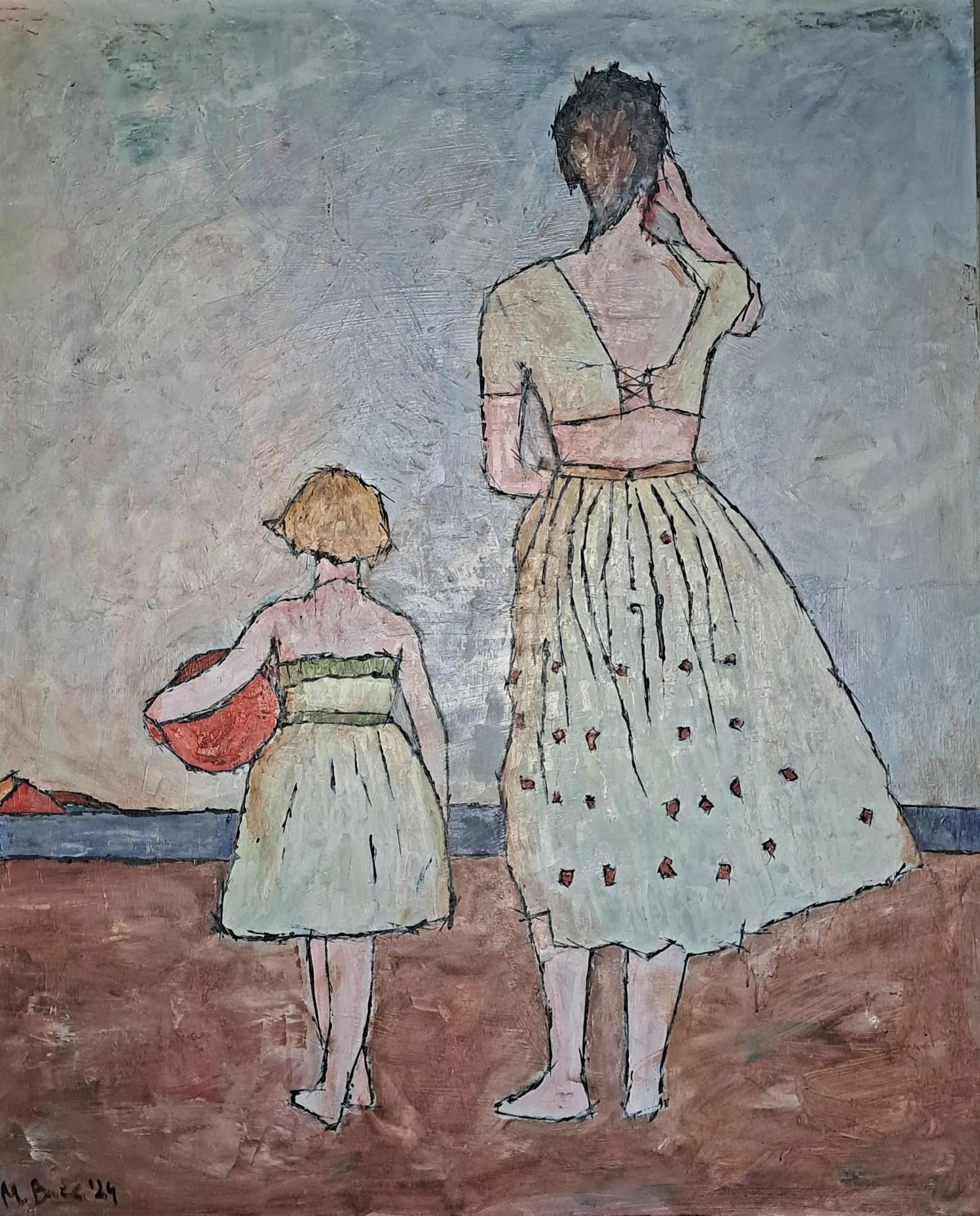
Horizon is one of those words that seem to belong to geography but in truth belong deeply to the philosophy of looking. In its simplest sense it is the limit of the visible, the line where sky and earth, nearness and distance, meet. But the horizon is not only what lies before us. It is the limit of our experience – the place where what we can see ends and what we can only sense begins. And that is precisely why the horizon is never final. As we approach it, it moves.
In this sense the horizon interests me as an existential and also a phenomenological space: as a relationship between the gaze and the world, between what we have been given and what we may yet become.
In the Horizons cycle I try to look at this space through woman. Not as a universal or single-meaning category, but as a complex meeting place of personal experience and social circumstance. In this cycle, woman is above all a question for me. Not a question that seeks a final answer, but one that, the closer we come to it, reveals itself to be ever more complex.
Perhaps that is why we most often see my figures from behind.
The absence of a face here is not merely a formal solution. It deliberately withholds the possibility of psychological certainty. It does not allow us simply to ‘read’ the figure. The woman remains beyond any final interpretation, and her gaze is turned towards a space that lies outside the painting. In this way the figure ceases to be merely an object of looking and becomes the subject of the gaze. She looks, and we try to imagine what she sees.
For me, this is where the true space of painting opens up.
For what does it really mean to have a horizon? Is a horizon something we choose for ourselves, or something determined by the circumstances in which we live? How far are our views shaped by family, society, time, expectations and our own experience? And where does an individual’s freedom to move their own horizon begin?
These questions become especially interesting when I consider them through the experience of women. Not because there is a single female horizon, but quite the opposite – because there are countless horizons. Every woman carries her own history, her own limits and her own possibilities. What is often invisible from the outside is precisely what interests me most as a painter.
My painting, therefore, does not try to explain woman. It tries to remain close to her inexplicability.
In this sense emptiness, distance, the figure’s back or the space beyond the frame become just as important as the figure itself. What is not painted becomes an active part of the painting. The viewer is compelled to fill the emptiness with their own experience, and so becomes part of the process of making meaning.
The ladders that appear in some of the works can be read as a sign of possibility: as a vertical that breaks through the given space and suggests a passage from one level of experience to another. They do not necessarily lead towards a particular goal. What matters is the very possibility of ascent, of a change of perspective, of stepping outside what is given.
That is why I do not see Horizons as a cycle about answers, but about the limits of our knowledge and the need to keep questioning them.
The woman we see from behind is not a riddle to be solved. She is a space of questions. Her horizon is not something the viewer can conquer, but a limit before which they must pause and admit that there is something they do not know.
And perhaps this is the most important function of art: not to explain to us what we are looking at, but to teach us to look for longer than what is given to us at first sight.
So for me the horizon is not the end of looking. It is the place where looking becomes aware of its limits – and, precisely because of that, begins to cross them.